
Pass-Through Clauses: Writing Pool Fees Into a Hosting Agreement
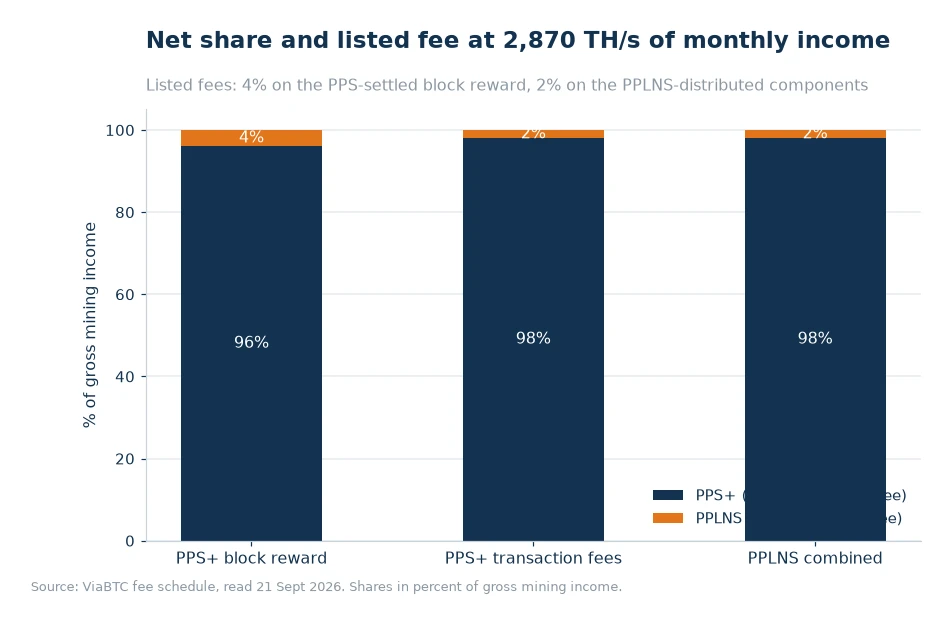
A hosting contract that passes pool costs to the miner is only as precise as its wording. At 2,870 TH/s the gross credit runs about $109.04 a day, the listed 4% on the block-reward component is $4.36, and the listed 2% on the PPLNS-distributed components is $2.18. A clause that names neither the rate nor the base will be argued about in month two.

Key takeaways
- Gross at 2,870 TH/s is $109.04 a day; the listed 4% is $4.36 and the listed 2% is $2.18 on the same base.
- A pass-through clause needs four items: the mode, the rate, the base and the settlement cadence.
- Passing through a percentage is fairer than passing through a fixed dollar amount, because it moves with difficulty.
- Cap the pass-through at a stated monthly figure if the client needs budget certainty; a cap is a price, not a fee.
Four items a clause has to name
Pool costs appear in a hosting agreement in one of three ways: absorbed into a single all-in rate, itemised as a separate line, or passed through at cost. The third is the most common and the most poorly drafted, because it sounds simple. At cost means at what cost, computed on which base, measured over which period, and verified against which statement.
Name the mode first. A settlement that pays hourly against current difficulty carries a different listed rate from one that shares block findings over a window, and the two behave differently when the pool has a slow week. Then name the rate, the base it applies to, and how often the charge is recalculated. Four items, one sentence each, and the clause stops being a negotiating position.
Three ways to write the same pass-through
The table compares wording that looks equivalent and is not. All three rows use the same gross figure; they differ in what happens when difficulty, price or the fee mix moves.
| Clause wording | Base used | Daily charge | Drift sits with |
|---|---|---|---|
| "4% of pool fees" | Undefined | Ambiguous | Whoever argues loudest |
| "4% of gross mining income" | Gross credit, block reward | $4.36 | Client, via the percentage |
| "2% of the PPLNS-distributed total" | Combined block reward and fees | $2.18 | Client, via the percentage |
| "$4.36 per day, fixed" | A single day in September | $4.36 now, less later | Host, as difficulty rises |
The fixed-dollar row is the one that causes trouble in the other direction. A host who agrees to a fixed charge has taken on the risk that difficulty rises and the percentage produces more than the fixed sum; a client who agrees to it has taken the benefit today and will be asked to renegotiate in six months. Percentages survive a difficulty change without a conversation.
Why the mode belongs in the clause, not the appendix
Two operations at identical hashrate can owe different amounts purely because of settlement mode. That is not a quirk of drafting; it reflects what each mode does with risk. Passing through the cost of a pay-per-share settlement and then quietly running the machines under a different mode leaves the client paying for a service they are not receiving, and the gap is invisible until someone reads the pool statement line by line.
Put the mode in the operative sentence and repeat it in the monthly report template. It costs one line and removes the most common source of disputes in a pass-through arrangement.
Worked example: costing the clause at 2,870 TH/s
Convert the contract into a monthly number, which is the figure both sides will actually check.
- Network output per terahash: 450 ÷ 1,003,000,000 = 0.00000044865 BTC a day.
- At 2,870 TH/s: 2,870 × 0.00000044865 = 0.00128762 BTC a day.
- Dollars: 0.00128762 × 84,692 = $109.05, carried as $109.04 in the chart note.
- Listed 4% on the block-reward component: 109.04 × 0.04 = $4.36.
- Listed 2% on the PPLNS-distributed components: 109.04 × 0.02 = $2.18.
- Thirty-day month: $3,271.20 gross, with a pass-through of $130.80 at 4% or $65.40 at 2%.
- At 5% higher difficulty the same clause yields 5% less in dollars but the same percentage, which is exactly what the wording intends.
That last step is the argument for the percentage. Nobody has to renegotiate when the network grows, because the clause already describes a share rather than a sum.
The month when the clause gets tested
It gets tested when the pool statement and the host invoice use different month-ends. A pool that settles hourly produces a clean figure; an invoice that runs from the fifth to the fifth does not. Specify that the pass-through follows the pool statement period, and attach the statement as the evidence document. Two numbers that cannot be reconciled should not both appear on an invoice.
It also gets tested when a machine is offline for repairs. Does the pass-through apply to a worker that produced nothing? A percentage of zero is zero, which is fair, but a host who charges a fixed daily sum will want it either way. Decide before the first repair, not during it.
A third test arrives with a promotion or a referral credit. If the pool reduces the effective cost, the pass-through should reduce with it; if it does not, the host has quietly converted a client benefit into margin. Say which party keeps a rebate, and say it in the same paragraph as the rate.
Language worth deleting on sight
Three phrases turn a pass-through into a dispute. "Standard fees" without a schedule attached. "As determined by the pool" without naming which document is authoritative. And "plus any applicable charges", which is an invitation. None of them are dishonest; they are simply unfinished, and the time to finish them is before anything is energised.
The ViaBTC Pool Fees page is the document to attach, because it states the listed rate against each component rather than a single blended number. If the host is sourcing capacity through a third party, the Miner Hosting directory is a reasonable place to see how providers describe their own service levels, which makes the comparison between two draft clauses easier to run.
A clause that has been costed at your own hashrate is hard to argue with. The Profit Calculator will give the gross for the hashrate you are contracting for, so the monthly pass-through can be written into the agreement as an example rather than left to the first invoice.
Frequently asked questions
Should a hosting agreement pass through a percentage or a fixed sum?
A percentage, if the goal is to avoid renegotiation. At 2,870 TH/s the listed 4% is $4.36 a day on a $109.04 gross, and that figure moves with difficulty on its own, while a fixed sum has to be revisited every time the network grows.
Which pool statement should the invoice reference?
The one covering the same period as the invoice, attached as evidence. An hourly settlement produces a clean daily series, so the host can quote the exact gross the percentage was applied to rather than an average that neither side can reproduce.
Does a pass-through clause include withdrawal costs?
Only if it says so. Mining payouts at ViaBTC carry no fee of their own, but a host may charge for handling or for on-chain transfers. Name each cost separately, because a clause that bundles them cannot be checked against any published schedule.
Attach the schedule, then sign
Print the fee page, staple it to the clause, and write the mode and the base into the sentence above it. Then run the arithmetic once at your contracted hashrate and put the result in the agreement as an example month. Two sides that have both seen the same worked figure rarely argue about the invoice, and the argument that does happen is about a real change rather than a drafting gap.
Sources: ViaBTC pricing, companies and calculator pages; the rates quoted are the published 4% on the block-reward component and 2% on the PPLNS-distributed components, as read on 21 Sept 2026. Chain inputs read 21 Sept 2026: network hashrate 1,003 EH/s, difficulty 132.76 T, subsidy 3.125 BTC per block, BTC $84,692. Published 24 Oct 2026[1].